
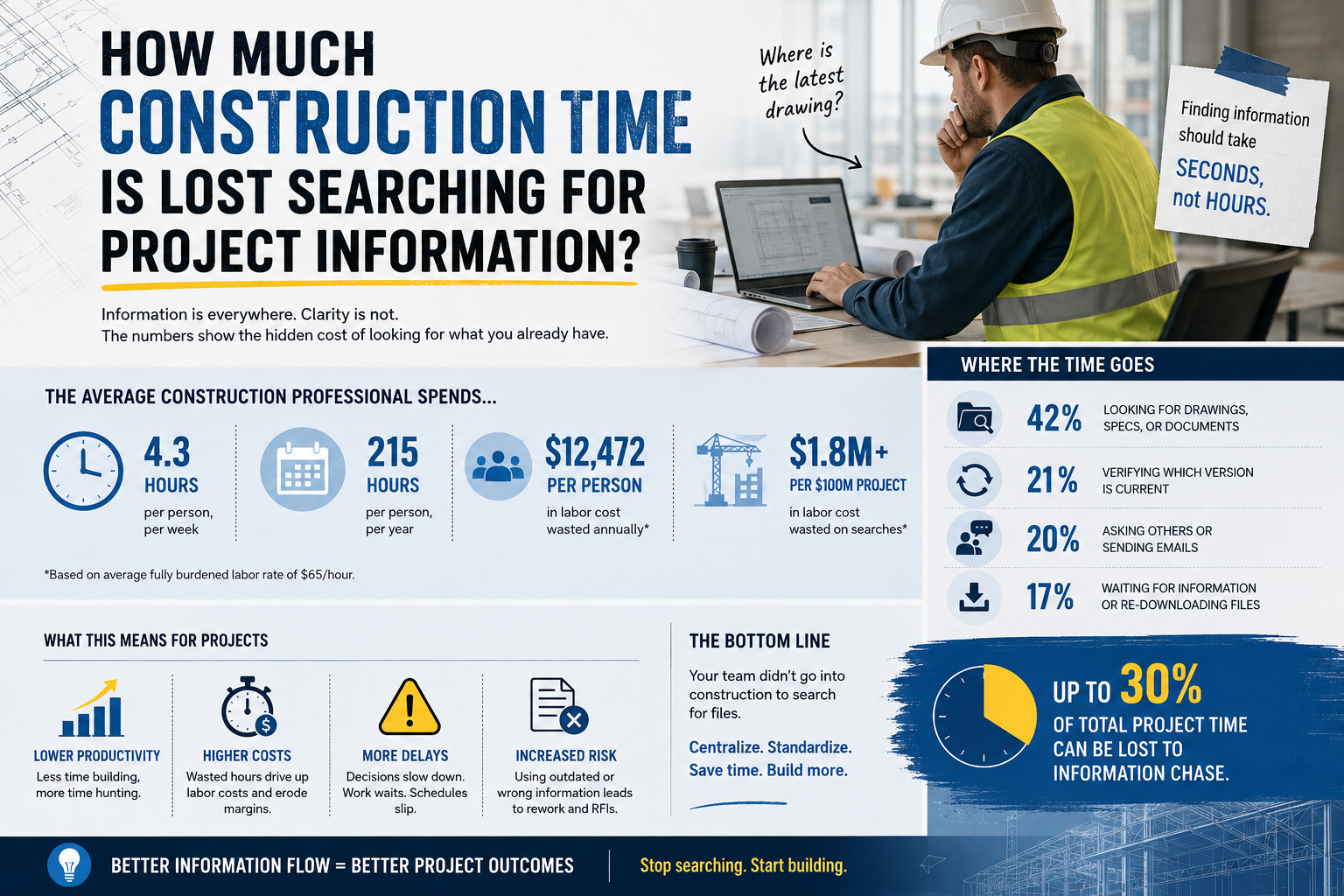
Construction teams spend a surprising amount of time looking for, reconciling and analyzing project information. We compare the major studies and explain where that time disappears.
|
IN SHORT • Autodesk/FMI research reported construction workers spending 35% of time on non-optimal activities including searching for information, conflict resolution and rework. • A separate Autodesk summary reports 13% of working hours devoted specifically to looking for project data and information. • Deloitte Access Economics research commissioned by Autodesk found construction leaders spending 11.5 hours per week looking for and analyzing data. • NIST estimated inadequate interoperability cost the U.S. capital-facilities industry $15.8 billion annually in a landmark 2004 study; the number is old but the failure mode remains recognizable. • The modern problem is less 'we do not have the information' and more 'we cannot get the right, current, connected information fast enough.' |
35%Time on non-optimal activities in an Autodesk/FMI field study |
13%Working hours reported as looking for project data/information |
11.5 hrsWeekly time looking for and analyzing data in Deloitte/Autodesk research |
Construction has become digitally rich.
A typical project may have cloud document management, BIM, estimating software, scheduling systems, field apps, email, chat, spreadsheets, specifications, drawing revisions, RFIs and submittals.
Yet project teams still lose time looking for answers.
That sounds contradictory until you separate data from usable information.
Having a file is not the same as being able to find the correct requirement, confirm that it is current, understand what it relates to and make a decision from it.
Three studies, three slightly different measures
Several frequently cited industry studies quantify the search burden.
An Autodesk/FMI study of field productivity reported that respondents spent 35% of their time — more than 14 hours per week — on non-optimal activities including looking for project information, resolving conflicts and dealing with mistakes and rework.
Another Autodesk data-strategy summary reports that 13% of construction professionals’ working hours are devoted specifically to looking for project data and information.
Deloitte Access Economics, in research commissioned by Autodesk and based on 1,275 construction leaders, reported an average of 11.5 hours per week spent looking for and analyzing data.
These figures are not directly interchangeable.
One includes conflict resolution and rework.
One isolates looking for information.
One combines searching and analysis.
But all three point in the same direction: information work consumes a meaningful portion of construction professionals’ time.
Why search takes so long
“Searching” on a construction project is rarely a single Ctrl+F action.
A project manager may be asked:
|
What is the required fire rating for this door? |
Finding the answer might require:
- Locate the door on the plan. 2. Read the door tag. 3. Find the door schedule. 4. Check the life-safety plan. 5. Find the wall type. 6. Search the relevant specification section. 7. Confirm the latest revision. 8. Determine whether an addendum changed the condition.
That is not file retrieval.
It is information reconciliation.
The seven forms of construction search
1. Location search
Where is the relevant document?
2. Version search
Is this the current issue?
3. Reference search
Where does this callout or note point?
4. Semantic search
Which specification section or note actually addresses the question?
5. Cross-document search
Does the same requirement appear somewhere else?
6. Change search
What changed from the previous revision?
7. Evidence search
What do I need to attach to prove or communicate the issue?
Each layer adds friction.
The interoperability problem is old
In 2004, NIST estimated that inadequate interoperability imposed an annual cost burden of $15.8 billion on the U.S. capital-facilities industry.
The study is more than two decades old, so the dollar value should not be treated as a current estimate.
But the underlying problem remains familiar: information has to move among architects, engineers, contractors, specialty fabricators, suppliers and owners across different systems.
Modern cloud platforms have improved access dramatically.
At the same time, the amount of project data has expanded.
Autodesk/FMI reported that project data volume had doubled over a three-year period.
Digitization can therefore solve one problem while creating another: the haystack becomes searchable, but it also becomes much larger.
Why centralization alone does not solve the issue
A common response is “put everything in one platform.”
That helps.
Centralized document control reduces version confusion and access problems.
But a central repository does not automatically tell you:
· Which note conflicts with which schedule
· Whether a detail reference is valid
· Which drawing changed
· Whether the specification agrees with the plan
· Which discipline depends on a revised condition
Document management is necessary.
Document understanding is a separate problem.
What search time costs a team
Consider a five-person preconstruction team.
If each person loses only five hours a week to avoidable document hunting, that is 25 hours per week.
Across 48 working weeks, that is 1,200 hours.
At a fully loaded labor cost of $75 per hour, the annual labor value is $90,000.
That example is illustrative, not an industry benchmark.
The point is that small weekly inefficiencies compound.
And the cost is not only labor.
Slow access to information can influence:
· Bid completeness
· Procurement timing
· RFI response
· Coordination meetings
· Schedule decisions
· Field productivity
· Change management
The real productivity loss is context switching
There is another cost that time studies do not capture well.
Search fragments attention.
A coordinator reviewing a structural conflict may switch among:
· PDF viewer
· Specification
· Procore/ACC
· Spreadsheet
· BIM viewer
· Previous drawing issue
Each switch imposes a cognitive reset.
Even if each file opens quickly, the reviewer has to reconstruct context.
That is why information retrieval feels disproportionately exhausting relative to the minutes recorded.
Search gets harder as packages grow
A 30-sheet tenant fit-out and a 250-sheet hospital package are different information problems.
The number of pages grows linearly.
But the number of possible relationships does not.
A detail may reference another sheet.
A mechanical unit may depend on structure and electrical.
A wall type may connect architectural, fire, structural and specification information.
As the package grows, the reviewer increasingly works with a network of dependencies rather than a stack of pages.
Why AI search is useful — and where it can fail
AI-assisted document search can reduce the need to know the exact keyword or document location.
ConstructConnect, for example, describes an AI document assistant that can answer questions about project scope, materials, specifications and milestones and return source context.
This is a good use of AI because the human's objective is retrieval, not autonomous decision-making.
But search accuracy matters.
If the system answers confidently from the wrong revision or misses a table, it can accelerate the wrong decision.
The requirement should therefore be:
Answer + source + version + context.
Not answer alone.
From search to review
Search tools answer:
|
Where is the information? |
Construction review asks a harder question:
|
Does the information agree with the other information that matters? |
That shift is important.
Finding a 90-minute rating in the specification is useful.
Finding that the door schedule says 45 minutes is coordination.
The second task requires relationship checking, not just retrieval.
Practical ways to reduce search waste
Standardize document naming
Predictable naming reduces location and version search.
Enforce a single current-document source
Teams should know where the authoritative issued set lives.
Make revision status visible
Do not force field users to infer which file supersedes another.
Link RFIs and issues to source documents
Evidence should travel with the question.
Use searchable specifications
Scanned, poorly structured PDFs increase search friction.
Capture relationships
A project-information system should know that a note, detail, schedule and specification are related.
Measure search pain
Ask teams which recurring questions consume the most time. Those are the best automation candidates.
The takeaway
Construction does not have an information shortage.
It has a relevance problem.
The industry has digitized an enormous amount of project content, but professionals still spend substantial time finding, reconciling and validating what they need.
The next productivity gain is not simply “put the documents online.”
It is getting from question to verified source faster — and then checking whether related project information agrees.
Sources and further reading
- Autodesk / FMI — Construction Disconnected. Field-study summary reporting 35% of time on non-optimal activities and more than 14 hours per week. https://www.autodesk.com/blogs/construction/construction-disconnected-fmi-report/
- Autodesk Construction — You Have Data, But Do You Have Construction Insights?. Reports 13% of working hours devoted to looking for project data/information. https://construction.autodesk.com/resources/data-analytics-reporting/you-have-data-but-do-you-have-construction-insights/
- Deloitte Access Economics / Autodesk — State of Data Capabilities in Construction. Global survey of 1,275 construction leaders; 11.5 hours/week looking for and analyzing data. https://construction.autodesk.com/go/deloitte-construction-data-report/
- NIST — Cost Analysis of Inadequate Interoperability in the U.S. Capital Facilities Industry. Landmark 2004 interoperability-cost study. https://www.nist.gov/publications/cost-analysis-inadequate-interoperability-us-capital-facilities-industry
- ConstructConnect — Ask Documents. Industry example of AI-assisted project-document search with source traceability. https://www.constructconnect.com/blog/ask-documents-a-faster-way-to-get-clear-answers-from-project-documents
- RIB — Construction Document Management. Practical overview of document fragmentation, search time, version control and rework. https://www.rib-software.com/en/blogs/construction-document-management